Imprint & Privacy
Cast Spells on Product Discovery
From Assumptions to Evidence: The Power of Data-Driven PRDs
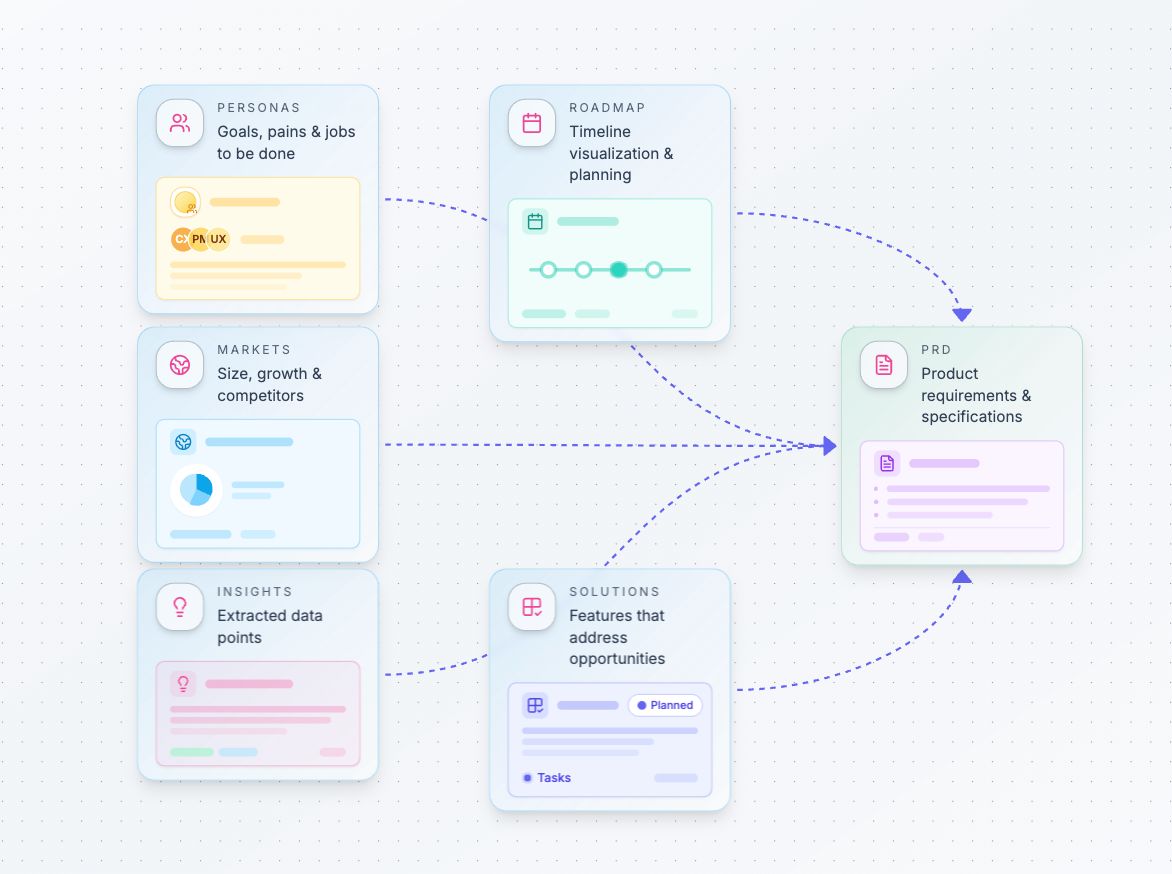
Table of ContentsThe Problem with Traditional PRDsWhat Makes a PRD "Data-Driven"?1. Direct Links to Customer Research2. Integrated Market Context3. Connected Personas4. Validated Hypotheses5. Living DocumentationThe Business ImpactFaster Stakeholder Buy-InReduced Feature WasteConfident PrioritizationStronger Team AlignmentBuilding Your First Data-Driven PRDStep 1: Start with Discovery, Not DocumentationStep 2: Define Your Market and Personas with DataStep 3: Validate Hypotheses Before They Become RequirementsStep 4: Build Your PRD by Connecting the DotsStep 5: Keep It AliveCommon Pitfalls to AvoidPitfall 1: Analysis ParalysisPitfall 2: Treating It Like a ReportPitfall 3: Disconnecting After LaunchPitfall 4: Making Connections Too GranularThe Tools That Make It PossibleFrom Documents to DecisionsReady to Transform Your PRD Process?
The Problem with Traditional PRDs
Product Requirements Documents have been a cornerstone of product management for decades. And if you’ve shipped software with a team, you’ve probably written (or survived) more than a few of them. Yet despite their ubiquity, most PRDs share a critical flaw: they’re built on assumptions, not evidence .
Consider the typical PRD creation process. A product manager interviews a few stakeholders, reviews analytics dashboards, maybe conducts some customer interviews, and then synthesizes everything into a comprehensive document. The problem is subtle but painful: by the time the PRD is “done,” the connection to the underlying research has been severed. Requirements appear as declarative statements with no traceable link back to the insights that inspired them.
When a stakeholder asks “Why are we building this?” or an engineer questions “Who actually needs this feature?”, the PM scrambles to reconstruct the story. The research exists somewhere—buried in interview notes, scattered across Slack threads, or trapped in someone’s memory—but it isn’t accessible where it matters most. And because it isn’t accessible, the PRD becomes a debate club instead of a decision tool.
This disconnect has real consequences. According to product management research, 68% of product features are rarely or never used . Why? Because too many products are built on assumptions that were never validated with real users. The PRD might be beautifully written, but if the requirements aren't grounded in customer reality, the resulting product will miss the mark.
What Makes a PRD "Data-Driven"?
A Data-Driven PRD fundamentally changes this paradigm. Instead of treating requirements as isolated statements, it maintains living connections between every product decision and the evidence that supports it. If someone challenges a requirement, you can point to the exact interviews, insights, or experiments that earned it a place in the plan.
Here’s what distinguishes a Data-Driven PRD in practice. Notice that each element is designed to answer the same question: “What are we building, and what’s the proof?” That question is the bar, and it keeps the conversation honest. When you build your PRD this way, reviews get faster and decisions get calmer.
1. Direct Links to Customer Research
Every requirement connects directly to specific customer interviews, validation sessions, or user research. When your PRD states “Users need the ability to export data in CSV format,” that requirement links directly to the sessions where multiple customers explicitly requested it. Stakeholders can click through to see the actual quotes, understand the context, and confirm the need is real. Here’s the kind of evidence trail you want in front of you during a review, not hidden in a folder somewhere.
2. Integrated Market Context
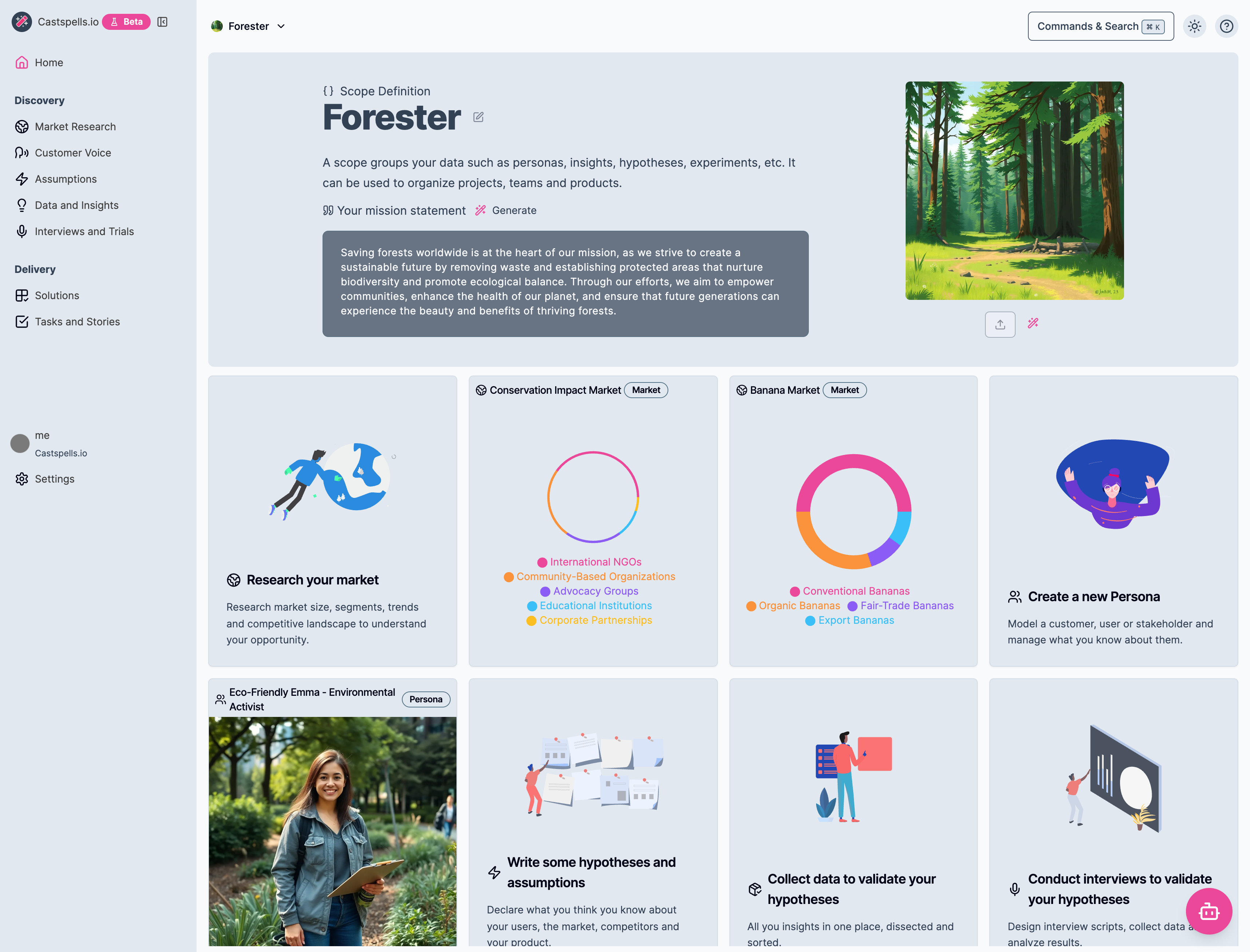
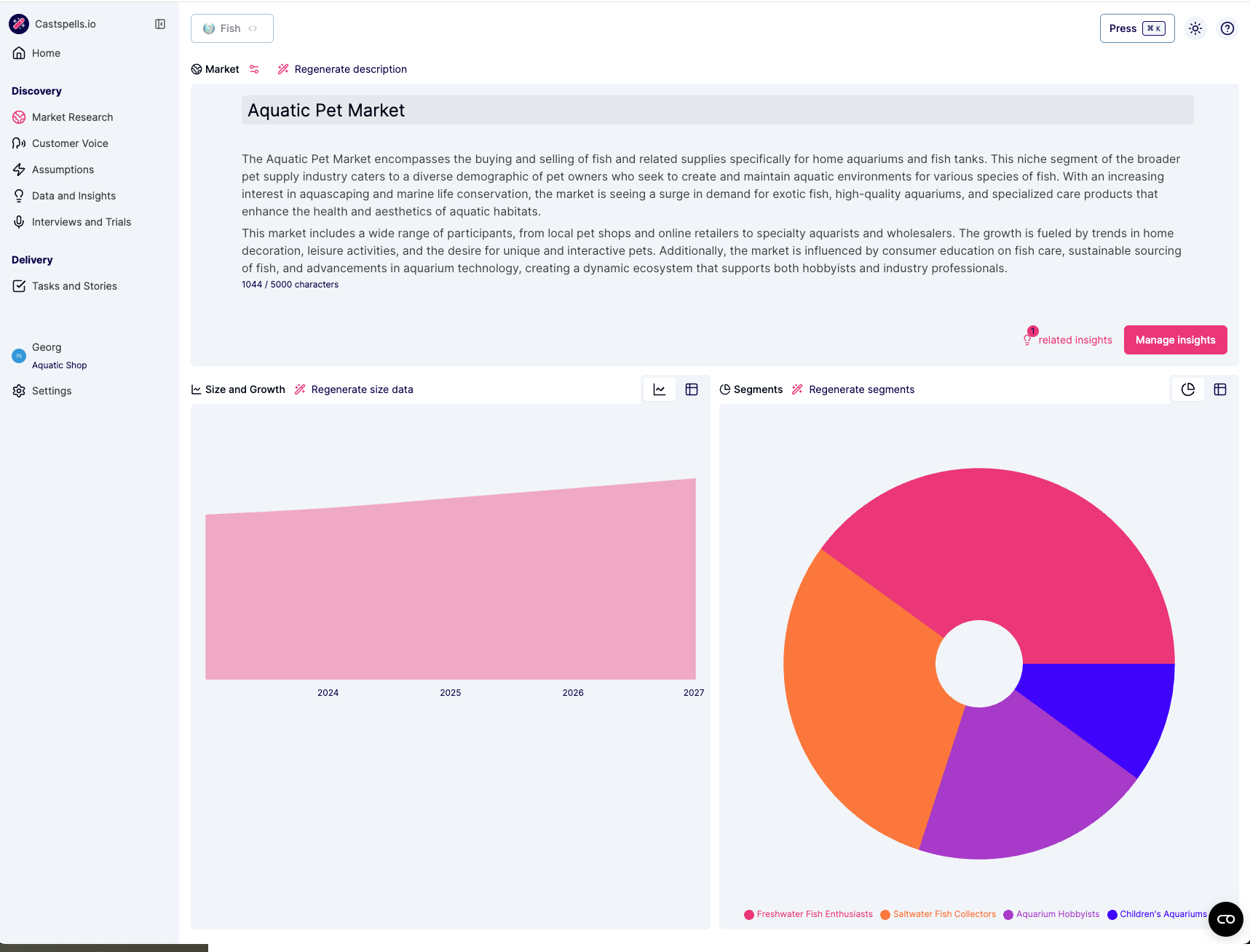
Instead of summarizing market research in a paragraph, Data-Driven PRDs embed market context directly in the document. Market size, growth rates, customer segments, and competitive trends show up where decisions are made, not as a detached appendix. This keeps strategy grounded in market reality instead of whatever was true the day the PRD was written. When the market view lives alongside the plan, it’s much easier to spot mismatches between “big opportunity” and “small impact feature.”
3. Connected Personas
Traditional PRDs might say “Our target user is a busy professional,” and then everyone silently projects their own mental image onto that phrase. Data-Driven PRDs go deeper by linking to personas built from actual research, complete with validated goals, frustrations, and behaviors. When requirements reference a persona, you’re pointing to evidence, not stereotypes, and the team gets on the same page quickly. This is especially helpful when two stakeholders say they’re talking about the “same” user, but they’re actually describing different segments.
4. Validated Hypotheses
The best product decisions start as hypotheses that get tested and validated. Data-Driven PRDs connect requirements to the hypotheses that were validated through experiments, interviews, prototypes, or lightweight trials. You can see not just what is being built, but which assumption it was designed to test and what evidence confirmed it was worth building . When you make hypotheses explicit, you also make it easier to say “not yet” to ideas that haven’t earned the right to become requirements.
5. Living Documentation
Perhaps most importantly, Data-Driven PRDs remain alive and current . When customer research uncovers new insights, when market conditions shift, or when validation experiments complete, the PRD reflects those updates without a manual rewrite marathon. That way you’re not managing an “official” PRD that everyone knows is stale.
The Business Impact
The benefits of Data-Driven PRDs extend far beyond better documentation. You’ll feel it in stakeholder conversations, in prioritization discussions, and in the team’s day-to-day confidence. In other words, it’s not just nicer paperwork—it’s a different way of making decisions.
Faster Stakeholder Buy-In
When every requirement is backed by visible evidence, stakeholder reviews become collaborative discussions rather than contentious debates. Instead of arguing opinions, teams examine data together. One product team at a B2B SaaS company reduced their PRD review cycle from three weeks to five days by implementing Data-Driven PRDs—stakeholders could verify claims instantly without scheduling follow-up meetings.
Reduced Feature Waste
By maintaining tight connections between requirements and validation data, teams naturally filter out features that lack supporting evidence. If you can't connect a requirement to validated customer needs, it probably shouldn't be in your PRD. This discipline dramatically reduces the dreaded "feature bloat" that plagues so many products.
Confident Prioritization
When facing tough prioritization decisions, Data-Driven PRDs provide clarity. Which features impact the most personas? Which requirements address the most validated pain points? Which capabilities align with your largest market opportunities? The answers are visible in the document itself, making prioritization more objective and defensible.
Stronger Team Alignment
Engineers, designers, and marketers all benefit from seeing the "why" behind requirements. When the entire team understands which customer problems they're solving and what evidence validates those problems, they make better decisions autonomously. This reduces the number of clarifying questions, speeds up development, and improves product outcomes.
Building Your First Data-Driven PRD
Transitioning to Data-Driven PRDs requires both a mindset shift and the right tools. The good news is you don’t have to do it all at once, and you don’t need to redesign your entire process to start. Here’s a practical way to begin with your next PRD.
Step 1: Start with Discovery, Not Documentation
Don't begin with a blank PRD template. Begin with customer research. Conduct interviews, run validation experiments, and gather insights first . Document your findings in a structured way that makes them referenceable later. Each insight, hypothesis validation, and customer quote becomes a building block for your PRD.
Step 2: Define Your Market and Personas with Data
Before writing requirements, establish clear market context and target personas using validated research. Document market size, growth trends, and customer segments with actual data sources. Build personas from real customer interviews, not assumptions. These become the foundation that all requirements connect to.
Step 3: Validate Hypotheses Before They Become Requirements
For each potential feature or capability, frame it as a testable hypothesis: “We believe [target persona] needs [capability] because [assumed reason].” Write it down as a real bet, not a vague idea you can’t measure. Run lightweight validation experiments—customer interviews, landing page tests, prototype feedback—to confirm or refute each hypothesis. Only validated hypotheses become requirements in your PRD.
Step 4: Build Your PRD by Connecting the Dots
Now construct your PRD by linking requirements to the research that validates them. Start with an overview that points to market context and strategic positioning, so the “why now” is obvious. Then anchor your requirements in the personas and insights you’ve already validated, and define success metrics that reflect outcomes customers told you they want. Finally, sequence validated features on a roadmap that reflects priority and dependencies, so execution has a clear path instead of a wish list. Here’s what this kind of connected PRD view looks like when the plan and the evidence live together.

The key is that every claim in your PRD should trace back to evidence . If you can’t make that connection, the requirement needs more validation before it belongs in the document. This rule feels strict at first, but it quickly becomes liberating because it removes a lot of politics from the process.
Step 5: Keep It Alive
Traditional PRDs become obsolete the moment they're approved. Data-Driven PRDs evolve as your understanding deepens. When new customer interviews surface additional insights, when validation experiments confirm or refute assumptions, when market conditions shift—your PRD reflects these changes automatically by maintaining living connections to your research data.
Common Pitfalls to Avoid
Even with the right approach, teams commonly stumble in a few areas. Most of these pitfalls come from treating “data-driven” like a checkbox instead of a habit. If you watch for them early, you’ll keep the process lightweight and genuinely useful.
Pitfall 1: Analysis Paralysis
Don't let perfect be the enemy of good. You don't need 100 customer interviews before writing your PRD. Start with enough evidence to validate core assumptions, then iterate as you learn more. A Data-Driven PRD with 80% confidence is better than a traditional PRD with 0% traceability.
Pitfall 2: Treating It Like a Report
A Data-Driven PRD is not a research report with appendices. It's a living document where evidence is integrated throughout, not relegated to a "Research Findings" section that nobody reads. Make the connections visible and accessible right where requirements are defined.
Pitfall 3: Disconnecting After Launch
The data-driven approach doesn't end when development begins. Continue connecting post-launch metrics, user feedback, and usage analytics back to your PRD. This closes the loop, showing which validated hypotheses proved accurate in production and which require iteration.
Pitfall 4: Making Connections Too Granular
Not every minor requirement needs five supporting data points. Focus on connecting the high-impact, high-risk, or contentious requirements to solid evidence. Use judgment about where evidence adds the most value versus where it creates unnecessary overhead.
The Tools That Make It Possible
Building truly Data-Driven PRDs requires more than just good intentions—it requires tools designed for this workflow. Traditional document editors can't maintain dynamic connections between requirements and research. Spreadsheets quickly become unwieldy. Disconnected tools force teams to manually synchronize information across platforms.
Modern product management platforms solve this by creating a unified workspace where evidence and planning live side by side. In practice, that means customer interviews and insights sit next to the PRD, personas can be embedded directly where they’re referenced, and validated hypotheses link back to the requirements they justify. It also means your market research stays current in the same system, and updates propagate anywhere they’re referenced instead of getting copied into a dozen docs. When the workspace is unified, the team spends less time “finding the source” and more time deciding what to do next.
This isn’t about adding more tools to your stack just for the sake of it. It’s about connecting the tools you already use into a coherent workflow where evidence and documentation exist in the same system. If you’ve ever chased a link chain from a PRD to a spreadsheet to a Notion page to a Slack thread, you already know why this matters.
From Documents to Decisions
The ultimate goal of a Data-Driven PRD isn’t better documentation—it’s better products . When requirements maintain living connections to customer research, market data, and validated hypotheses, teams make fundamentally different decisions. The PRD stops being a static artifact and starts acting like a shared source of truth.
They build features customers actually want because requirements trace back to validated needs. They prioritize confidently because evidence makes impact clear. They align stakeholders faster because claims are verifiable. They iterate intelligently because feedback loops are built into the process.
In a world where most product features go unused, Data-Driven PRDs offer a better path: build less, but build right . Ground every decision in evidence. Maintain connections between requirements and research. Let data guide strategy instead of assumptions.
The transition won't happen overnight. But start with one PRD, one feature, one requirement. Connect it to real customer research. Link it to validated hypotheses. Ground it in market data. Then watch how stakeholder conversations change, how team confidence grows, and how product outcomes improve.
Your PRD should tell two stories: what you’re building, and why the evidence proves it’s worth building. When you can tell both stories in one place, the document becomes useful long after kickoff. And when it stays useful, it stops being “documentation” and starts being leverage.
Ready to Transform Your PRD Process?
CastSpells Product AI helps product teams create Data-Driven PRDs that connect requirements to validated customer research, market data, and evidence-based insights. It’s built to keep the “why” attached to the “what,” so teams don’t lose context the moment planning turns into execution. If you want PRDs that stakeholders trust and teams can ship from, this workflow is a good fit.
You can conduct and document customer interviews with AI-powered transcription and insight extraction, and then turn those learnings into validated personas built from real customer data. You can also test hypotheses through structured validation experiments, and create living PRDs with dynamic connections back to everything you learned. Finally, you can visualize roadmaps that link planned features to the evidence that supports them, so prioritization stays defensible as things change.
Stop building PRDs on assumptions. Start connecting every product decision to validated evidence. If you want to see what this feels like in a real workflow, Start Your Free Trial and experience truly Data-Driven product planning.
Related Resources: If you want to go deeper, start with Maximizing Product Discovery: The Ultimate Guide to Customer Interview Preparation and make sure your inputs are solid. Then skim the PRD Documentation Guide to see how PRDs work inside CastSpells in a practical, hands-on way. Finally, check out the Product Discovery Process to see where evidence-driven PRDs fit into the broader end-to-end workflow.
Join the waitlist and adopt
ultimate product discovery
ultimate product discovery
Table of ContentsThe Problem with Traditional PRDsWhat Makes a PRD "Data-Driven"?1. Direct Links to Customer Research2. Integrated Market Context3. Connected Personas4. Validated Hypotheses5. Living DocumentationThe Business ImpactFaster Stakeholder Buy-InReduced Feature WasteConfident PrioritizationStronger Team AlignmentBuilding Your First Data-Driven PRDStep 1: Start with Discovery, Not DocumentationStep 2: Define Your Market and Personas with DataStep 3: Validate Hypotheses Before They Become RequirementsStep 4: Build Your PRD by Connecting the DotsStep 5: Keep It AliveCommon Pitfalls to AvoidPitfall 1: Analysis ParalysisPitfall 2: Treating It Like a ReportPitfall 3: Disconnecting After LaunchPitfall 4: Making Connections Too GranularThe Tools That Make It PossibleFrom Documents to DecisionsReady to Transform Your PRD Process?
Join the waitlist and adopt
ultimate product discovery
ultimate product discovery